
Decision-Making Process
One of the key researchers in the field of management and decision-making was Herbert Simon. He was, in fact, among the pioneers of artificial intelligence, information processing, decision-making processes, organizational theory, and other important scientific domains.
His work is still relevant because organisations today face the same core challenge, only in a more complex environment: how to make good decisions when information is spread across systems, documents, emails, reports, and people.
Digital transformation has changed the tools we use, but it has not changed the basic logic of decision-making. A company still needs to understand the situation, define the problem, compare possible solutions, choose the right direction, and implement the decision in practice.
The difference is that today, the quality of each step depends heavily on how well the organisation manages its information.
If employees cannot quickly find the right document, the current version, the relevant approval, or the context behind a business case, the decision-making process becomes slower and less reliable. The problem is not always a lack of data. In many organisations, the data exists. The issue is that it is hard to find, hard to trust, or disconnected from the process where the decision needs to happen.
Structured document management reduces the risk of decision-making based on outdated or incomplete data.
Digital Transformation – IT for Business Improvement
One useful way to define digital transformation is simple: IT used for business improvement. Basically, the application of digital capabilities and technologies in business processes, products, and models. Moreover, it is a cultural change. It changes how organisations work, communicate, approve, monitor, and make decisions.
This is where Simon’s work connects naturally with modern business environments.
There is no meaningful digital transformation without information processing, business intelligence, and organisational change. A company can introduce new systems, dashboards, and workflows, but if information remains fragmented, decision-making will still depend on manual checks, personal knowledge, and repeated follow-ups.
4 Phases of the Decision-Making Process
Simon’s model defines four phases of decision-making process:
- Intelligence Phase
- Design Phase
- Choice Phase
- Implementation Phase
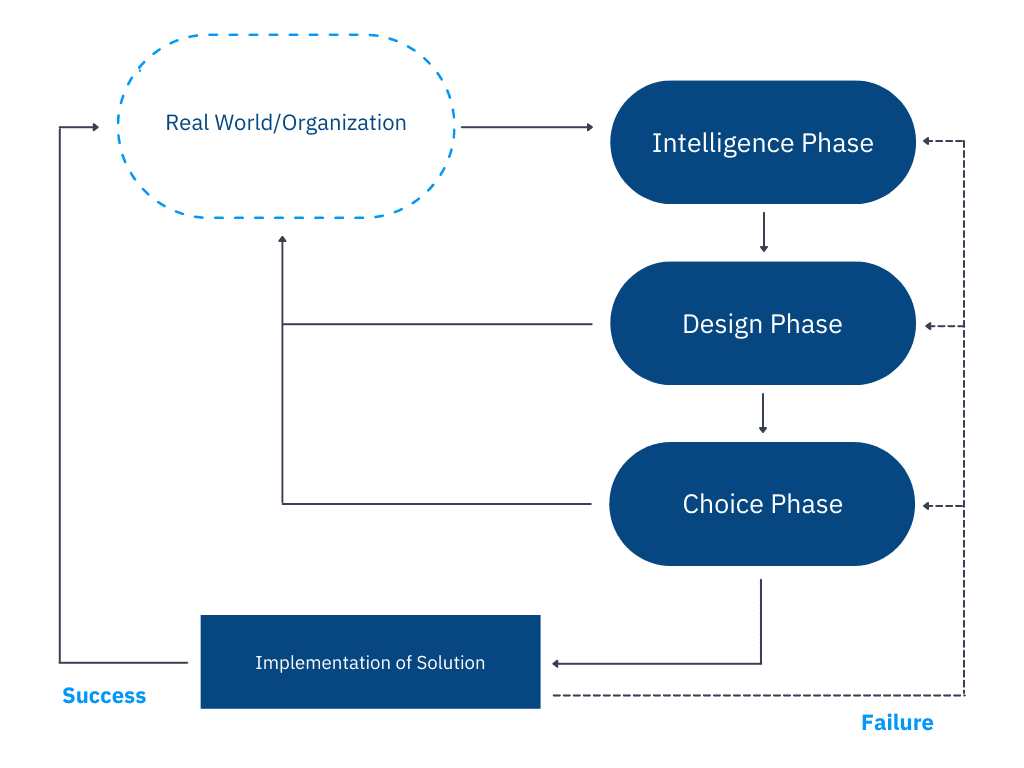
It’s important to note that first Simon’s model contained only three phases – implementation phase was added later. Also, we could add a fifth phase – monitoring, but that can be viewed as an input for the intelligence phase.
The model is useful because it shows that a decision is not only the moment when someone chooses an option. A decision is the result of several connected activities that happen before and after the choice itself.
In business, this is important. Many organisations focus on the final decision, but the quality of that decision usually depends on what happened earlier: how the problem was defined, which information was used, which alternatives were considered, and whether the chosen action could actually be implemented.
Intelligence Phase
Firstly, the decision-making process starts with the intelligence phase. In the first phase, decision makers examine reality and try to identify problems or opportunities correctly. This phase is not only related to the Simon’s decision-making process, but also to other fields and other methodologies. For example, we like to practice Lean Startup methodology which emphasizes the importance of right problem definition before building anything (product or business).
Additionally, one of the pillars of digital transformation is the data. Organizations need to become data driven. That means proper usage and implementation of Business Intelligence (BI) systems. Business Intelligence implementations are considered successful only if you have clear business needs and see real benefits from it. Business Intelligence is not just about data. It should be connected with organizational goals and objectives!
Therefore, intelligence phase includes actions like:
- Defining organizational objectives
- Data collection
- Problem identification and classification
- ….
The intelligence phase can last a really long time. But since the decision-making process starts with this phase, it should be done properly. This is a key ingredient in every business success.
Design Phase
The goal of the design phase is to define and construct a model that represents the system or situation. Decision-makers look at the variables, relationships, constraints, and possible outcomes. After that, they define the criteria for choosing between alternatives.
This phase is where organisations move from understanding the problem to designing possible responses.
For example, a company may identify that approvals are taking too long. In the design phase, it should not immediately jump to automation. It first needs to understand why approvals are slow.
- Are people waiting for missing documents?
- Is responsibility unclear?
- Are there too many manual checks?
- Is the process different in each department?
- Is the latest version of a document hard to identify?
- Are approvals happening outside the system?
If these questions are not answered, automation may only make the existing confusion move faster.
A good design phase connects the business problem with the operating model. It shows what needs to change in the process, what information is required, who needs to act, and which system should support the work.
This is also where business process automation becomes relevant. Automation is valuable when it follows a clear process. It can route tasks, trigger approvals, track status, reduce manual follow-ups, and make responsibilities visible. But it needs a defined process before it can create real value.
Choice Phase
In the choice phase, the organisation selects one alternative from the options defined earlier.
This is the moment people usually think of when they hear the word “decision”. But in a business environment, the choice is only as strong as the information and assumptions behind it.
A decision-maker may ask:
- Which option best supports the business objective?
- What evidence supports this choice?
- Which risks are acceptable?
- Who needs to approve or execute the decision?
- What information must be retained for future review?
The quality of the choice depends on whether the organisation can trust the information used in the process.
This is especially important in document-heavy decisions. Contracts, technical specifications, supplier documentation, project files, policies, approvals, and audit evidence often influence the final choice. If these documents are difficult to find or disconnected from the process, the decision becomes slower and more dependent on individual memory.
That is where better information management changes the decision-making process. It does not make the decision instead of the manager. It gives the manager a clearer basis for deciding.
Implementation Phase
All the previous steps we’ve made (intelligence, design, and choice) are now implemented.
Implementation can be successful or unsuccessful. If it fails, the organisation may need to return to an earlier phase and validate the problem, the model, or the choice. In many companies, implementation does not fail because the decision was obviously wrong. It fails because the work after the decision is not structured enough.
People may not know who owns the next step. Documents may not be updated. Approval status may be unclear. Exceptions may be handled through emails instead of a controlled workflow. The decision exists, but the process around it does not support consistent execution.
This is why decision-making should not be separated from process management. A decision creates value only when the organisation can act on it, track it, and learn from it.
Better decisions do not depend only on analysis. They also depend on whether employees can access accurate, current, and contextual information. When documents, approvals, and business data are scattered across emails, folders, and disconnected systems, teams spend time checking what is valid instead of moving the work forward.
At Unitfly, this is the type of operational problem we often connect with document management, workflow automation, and information structure. The goal is not to add technology for its own sake. The goal is to make business-critical information easier to find, easier to trust, and easier to use inside real processes.
How information management supports better decision-making
The decision-making process is often presented as a management model. But in practice, it is also an information-flow problem.
Each phase depends on information:
- Intelligence phase: What is happening and why?
- Design phase: What options are possible?
- Choice phase: Which option is best supported by evidence?
- Implementation phase: Who needs to do what next?
- Monitoring: What happened and what should change?
If the information is fragmented, each phase becomes more difficult.
This does not mean every company needs the same system or the same level of automation. The right solution depends on the process, the volume of information, compliance needs, integrations, and the way teams actually work.
But the starting point is always practical: look at one important decision that often takes too long.
- Where does the information live?
- Which documents are needed?
- Who needs to approve?
- Which version is valid?
- What must be visible later for audit or internal control?
- How much of the work depends on someone remembering where something is?
If the answer is spread across systems, folders, emails, and people, then improving the decision-making process starts with improving how information is managed.
Related solutions:
Centralise documents, versions, access rights, and business context so teams can work with information they can find and trust.
Structure approvals, tasks, and workflows so decisions can move through the organisation with clearer ownership and status.
M-Files Document Management Solutions
Connect documents, metadata, workflows, and permissions in one information management platform that supports business processes.
Want to make faster, more informed decisions?
Discover how centralizing information, automating routine work, and giving employees access to trusted data can improve decision-making across your organization. Download the eBook and learn more: