
Why Procure-to-Pay Process Needs Both ERP and Document Management
ERP is essential in the procure-to-pay (P2P) process. It gives finance, procurement, and operations the structure they need to manage suppliers, purchase orders, invoices, payments, and reporting. Without ERP, procure-to-pay does not scale.
But the P2P process is not just about managing a transaction.
In real processes, invoice approval often depends on information that sits outside structured ERP fields: contracts, delivery notes, purchase requests, approval comments, project context, and exception explanations. Some of this information is linked to the ERP transaction, but the full business context is often stored somewhere else.
That gap is where many finance processes slow down.
This is why the relevant question is not ERP or document management. ERP is a given. The real question is how ERP and document management work together when approvals depend on both structured data and document-based evidence.
This is also why we are covering the procure-to-pay process, invoice approval, and document context in our webinar. The challenge is not how invoices move through systems, but how companies keep enough context to approve and control them with confidence.
Where ERP reaches its limit
ERP works best when the process is structured.
It handles suppliers, purchase orders, invoice records, cost centers, accounting rules, payment status, and reporting. For finance leaders, this is non‑negotiable. ERP provides control and consistency.
The limitation appears at the approval stage.
An invoice can be perfectly registered in ERP and still require additional checks before approval:
• Was the purchase actually requested?
• Was it approved?
• Was the service delivered?
• Is there a signed contract?
• Does the invoice match the agreed terms?
These answers are often not fully captured in structured ERP fields. At that point, approval is no longer only a transaction decision. It becomes a context decision.
Invoice approval exposes the document problem
An invoice is rarely a standalone document. In practice, it belongs to a broader case: a purchase request, a purchase order, a contract, a delivery confirmation, a project, and an approval path.
A very typical situation looks like this:
• The invoice is visible in ERP.
• The contract is stored in SharePoint.
• The delivery note is attached to an email.
• The approval comment sits in Teams.
• The project context is known by one department manager.
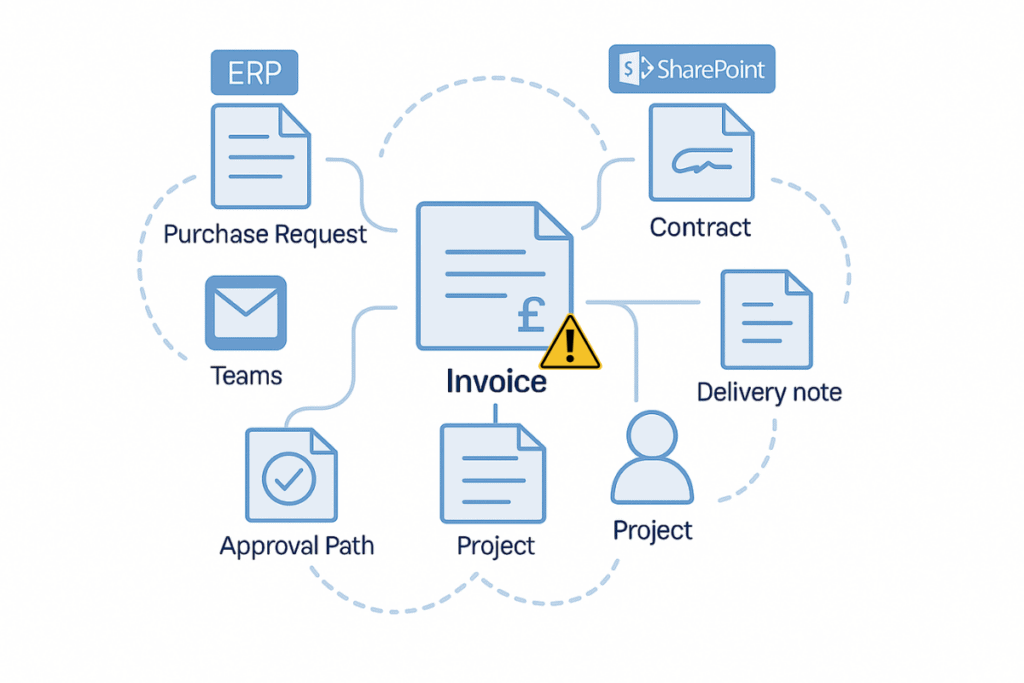
Nothing is missing; everything exists. Yet, finance still needs to assemble the full picture before approving the invoice.
That manual reconstruction is where time is lost and control becomes weaker.
Approval delays are often not caused by the invoice itself, but by missing or fragmented context around it.
The usual workaround: “store the documents somewhere”
ERP attachments
Many ERP systems allow documents to be attached to transactions.
For simple cases, this can be enough. If one invoice needs one supporting document, attachments work.
The problem starts when documents belong to more than one business context at the same time. A contract may relate to a supplier, several purchase orders, several invoices, and a project. A delivery note may support one invoice but also be part of a broader delivery process. Approval evidence may matter later for audit, not only for posting.
At that point, attaching files to a single ERP record stops being sufficient.
SharePoint and shared folders
SharePoint and shared folders are a common next step. They improve access and reduce paper. But folders organize documents by location, not by meaning.
A folder does not reliably tell you:
• which version is final
• which document supports which approval
• whether a document has already been used as evidence
• who should see it based on the business case
People may know this from experience, but systems don’t.
That is where storage alone reaches its limit.
Where document management adds value
Document management matters when documents are part of the process, not just records at the end of it.
Context through metadata
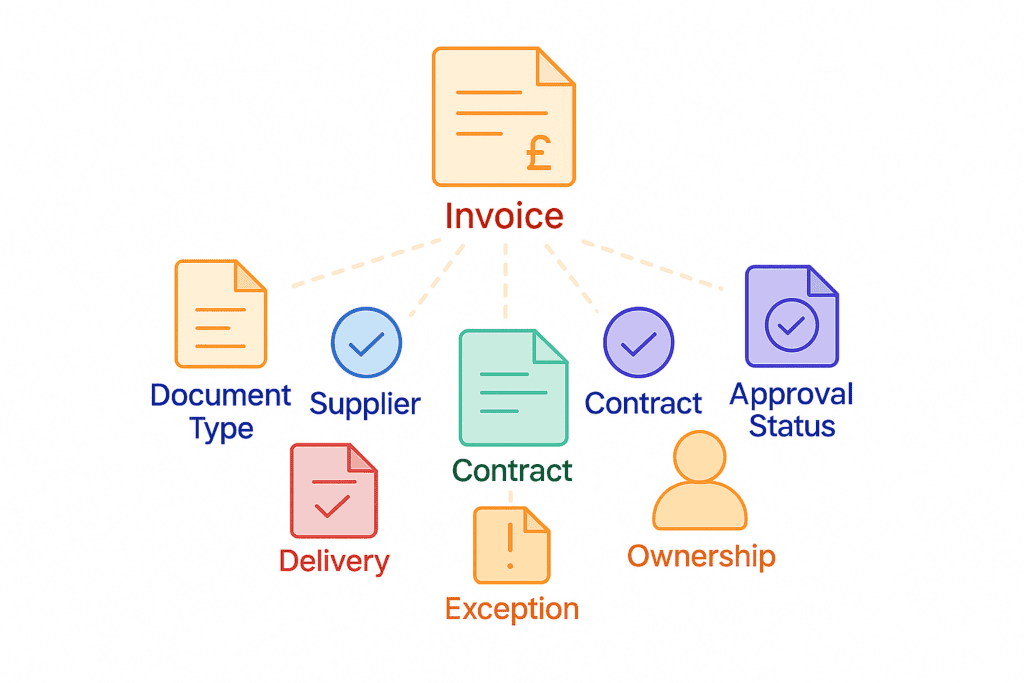
Documents become useful when they carry business context: document type, supplier, contract, invoice, project, approval status, version, and ownership.
This context makes documents understandable without relying on individual memory.
When an invoice is linked to the right contract, delivery evidence, project, and approval workflow, finance no longer needs to reconstruct the case manually.
Workflow and responsibility
Documents in the P2P process usually require these actions:
Someone reviews.
Someone approves.
Someone resolves an exception.
If documents are only stored, coordination happens manually. If documents are part of a workflow, responsibility and status are visible. This matters because approval paths can change over time.
Permissions and auditability
Procure-to-pay involves sensitive information.
Access should depend on business context, not only on folder location. Auditability should show who saw which document, when, and why a decision was made.
ERP records the transaction. Document management records the evidence around it.
Why this matters even more with AI
AI can read documents. That does not mean it understands them.
If documents are stored as disconnected files, AI may extract text but still lack context:
• Which contract version is final?
• Which invoice is valid?
• Which delivery note supports which approval?
• Who is allowed to see the answer?
Without structure, AI can surface information faster — but not necessarily more reliably. AI readiness is, therefore, less about the interface and more about information quality.
In the P2P process, that means documents need to be connected to suppliers, invoices, contracts, approvals, permissions, and status. Otherwise, AI exposes the same uncertainty faster.
How to think about improving P2P
Before adding tools or automation, start by asking what evidence the approver needs in order to approve or reject the invoice.
Ask:
• What information does the approver need?
• Which documents support the approval?
• Where are those documents stored?
• Who should have access to them?
• Which version is the official one?
• What must be recorded for audit?
If approval depends mainly on structured ERP data, ERP may be enough.
If approval depends on contracts, delivery notes, exceptions, versions, permissions, and evidence, document management becomes critical.
This is where Unitfly usually sees the biggest improvement opportunities: not by replacing ERP, but by structuring the document layer around the ERP transaction.
Conclusion
ERP is the backbone of the procure-to-pay process.
But invoice approval often depends on information outside the transaction itself. When that context is fragmented, processes slow down and control weakens.
Document management adds value by connecting documents to the business process: context, workflow, permissions, and auditability.
The practical starting point is simple: look at where procure-to-pay decisions depend on documents outside ERP.
That is usually where the real problem (and the real opportunity for improvement) lies.
If you are currently reviewing how procure-to-pay works in your organization, this is one of the topics we cover in our webinar: how invoice approval changes when ERP data, documents, and AI readiness are treated as one connected process.
FAQ
Does a document management system replace ERP?
No. ERP remains the system for structured financial and transactional logic. Document management supports the document‑heavy parts of the process around approval and control.
Are ERP attachments or SharePoint enough?
They can be for simple cases. The limitation appears when documents relate to multiple business contexts and need workflow, permissions, version control, and audit history.
Why does document management matter for AI readiness?
AI needs context, not just files. Without structured, governed documents, AI may read information without understanding which document represents the business truth.